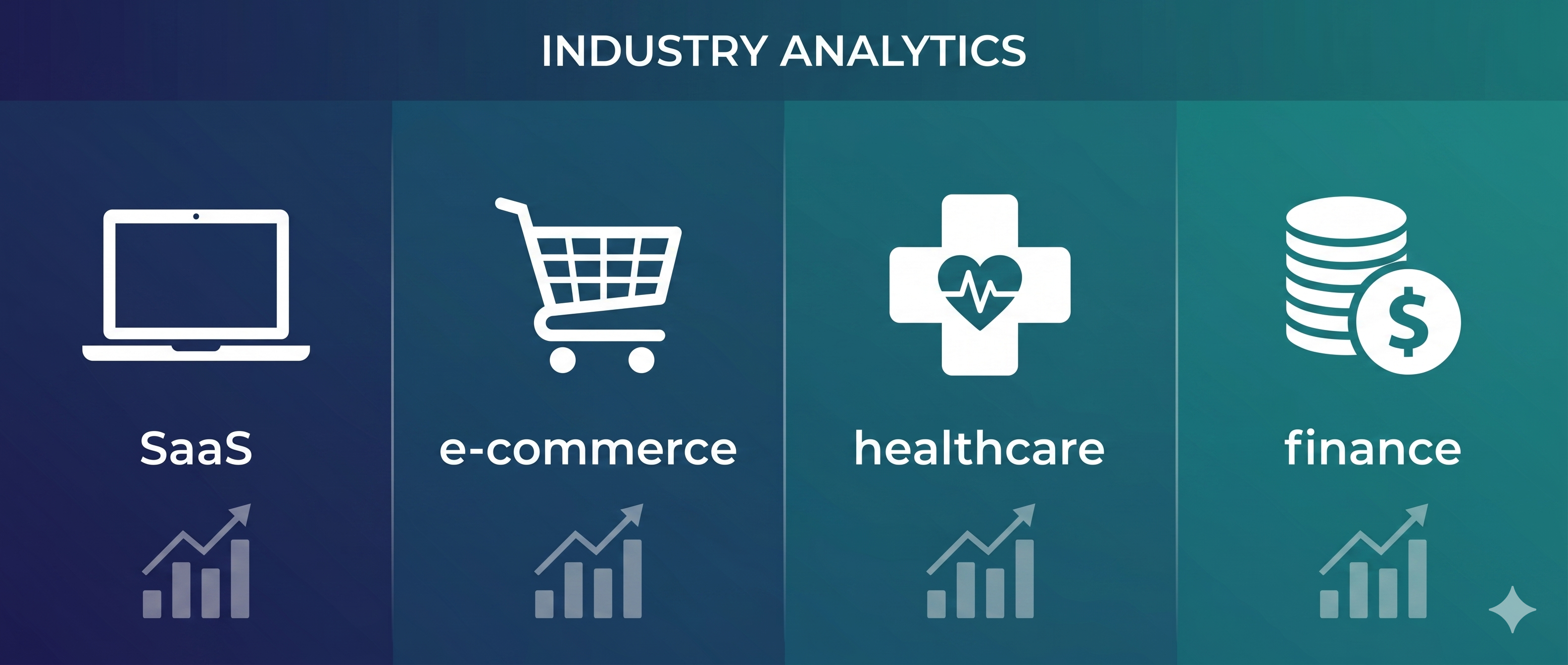
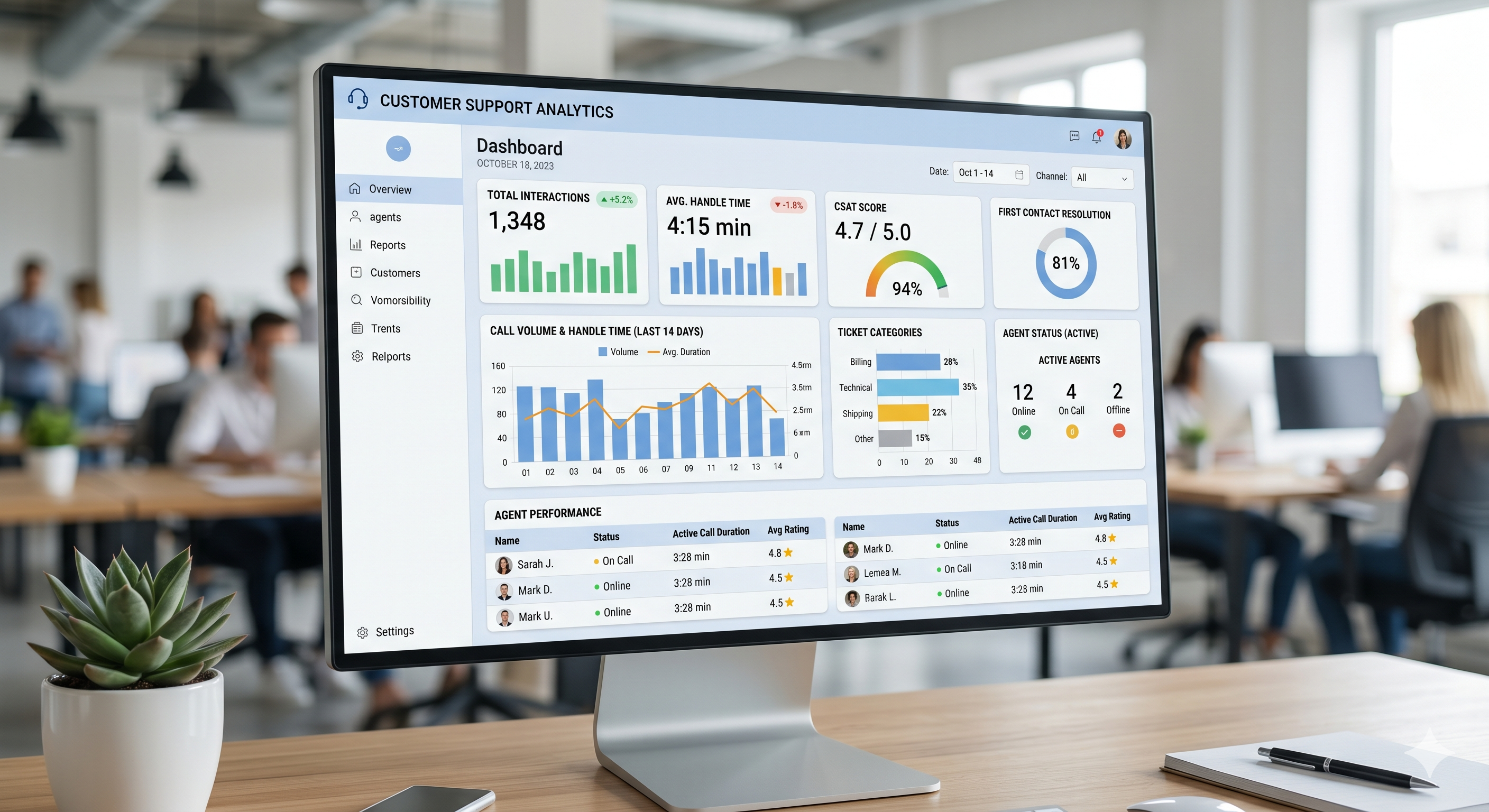
Call center benchmarks by industry: what good looks like in SaaS, e-commerce, healthcare, and finance
Industry-specific call center benchmarks for SaaS, e-commerce, healthcare, and finance teams. AHT, FCR, CSAT targets that actually apply to your sector.
A 6-minute AHT is excellent in financial services and alarming in e-commerce. Industry benchmarks diverge significantly, yet most roundups report a single average. This breakdown covers the metrics that matter most in SaaS, e-commerce, healthcare, and finance, with realistic targets for each. For the full statistical overview, see the 2026 call center statistics.
1. Why industry benchmarks differ (and why generic averages mislead)
A single average AHT across all industries is like an average commute time across all cities. Technically accurate, practically useless. The complexity of the interaction, the regulatory environment, and customer expectations vary so much by sector that a metric that signals excellent performance in one industry can signal a serious problem in another.
Generic benchmarks also pool together companies with wildly different products, customer bases, and support models. A SaaS startup handling API integration questions and a pharmacy handling prescription refills are both running call centers. They share almost nothing else.
The sections below give you numbers you can actually use to evaluate your team. Use the 2026 call center statistics as the baseline context, then apply the industry-specific targets here. For a practical framework on building a call center, see the complete call center guide.
2. SaaS and tech support: metrics, targets, and what drives them
SaaS support handles technically complex issues that often require screen sharing, log analysis, or multi-step troubleshooting. Customers are generally tech-literate and expect fast, accurate answers. They tolerate slightly longer calls if the resolution is complete.
Metric
SaaS target
Notes
AHT
3–5 minutes
Higher complexity justifies longer calls
FCR
75%+
Benchmark for B2B SaaS; B2C can target 80%+
CSAT
85–90%
High bar due to technically sophisticated customers
First response time
Under 2 minutes
Chat and phone; email within 4 hours
Abandon rate
Under 5%
Low tolerance for wait times in SaaS
The key driver in SaaS is resolution accuracy, not raw speed. A call resolved in 3 minutes that requires a follow-up costs more than a 7-minute call that closes the issue completely. FCR above 75% is achievable when agents have access to a well-structured knowledge base and clear escalation paths.
Async communication (in-app chat, email) handles a high proportion of SaaS support volume, which keeps call AHT lower than it might otherwise be. Phone calls in SaaS tend to be reserved for critical issues, which pushes AHT up compared to sectors with higher routine call volume.
3. E-commerce support: speed wins, but accuracy matters more
E-commerce support is high volume and highly seasonal. The majority of contacts are order status, returns, and delivery questions, all of which have short, predictable answers. Customers want resolution in under 3 minutes. Anything longer signals an inefficient process, not a complex problem.
Metric
E-commerce target
Notes
AHT
2–4 minutes
Routine queries should resolve quickly
FCR
80%+
Most issues are straightforward if agents have order data
CSAT
80–85%
Lower bar than SaaS due to transactional nature
Abandon rate
Under 8%
Critical during peak season; target 5% off-peak
First response time
Under 1 minute
Speed is a primary driver of satisfaction
Abandon rate is the most important metric to watch in e-commerce, particularly during peak periods like Black Friday or holiday season. A single week with a 15% abandon rate during peak can generate hundreds of repeat contacts and negative reviews.
Staffing plans need to account for volume spikes of 3 to 5 times baseline during peak periods. Call center software that supports easy agent scaling and queue visibility is critical. Callback queues significantly reduce abandonment when wait times exceed 90 seconds.
4. Healthcare and insurance: compliance adds complexity
Healthcare call centers operate under regulatory constraints that directly affect how metrics look. HIPAA in the US and equivalent regulations in other markets restrict what agents can say, what can be recorded, and how identity verification must be handled. All of this adds time.
Metric
Healthcare target
Notes
AHT
8–12 minutes
Verification, compliance steps add time
FCR
70–75%
Complex issues often require follow-up
CSAT
78–82%
Patients are often in distress; empathy matters
First response time
Under 3 minutes
Wait times strongly affect patient satisfaction
Abandon rate
Under 6%
Patients with urgent needs will not wait
Call recording in healthcare requires verbal consent at the start of the call in many jurisdictions. This adds 20 to 30 seconds to every interaction but is non-negotiable for compliance. Build this into your AHT baseline rather than treating it as an anomaly.
FCR is harder to achieve in healthcare because many queries require coordination with clinical staff or third-party systems. A realistic target of 70 to 75% accounts for this. Pushing for higher FCR without the necessary integrations and agent authority will produce false closures and repeat contacts.
Join our newsletter
The latest tips and deals delivered straight to your inbox.
5. Financial services: accuracy over speed
Financial services call centers prioritize accuracy and auditability above all else. A wrong answer about account status, a regulatory product, or a fraud claim has legal and financial consequences. Speed is secondary. Customers in financial services accept longer calls when they receive a definitive, accurate resolution.
Metric
Financial services target
Notes
AHT
6–10 minutes
Verification and compliance extend calls
FCR
78–82%
High FCR critical; repeat contacts = compliance risk
CSAT
75–82%
Customers are often calling about problems
First response time
Under 2 minutes
Waiting on hold with a financial issue erodes trust
Abandon rate
Under 5%
Low tolerance; customers will go elsewhere
Audit trail requirements mean that call recording is near-universal in financial services. Unlike healthcare, consent is typically covered by terms and conditions rather than verbal confirmation, which keeps the AHT impact minimal. What does add time is the identity verification process, which typically runs 60 to 120 seconds per call.
The FCR/AHT tradeoff in financial services tilts toward FCR. A slightly longer call that definitively resolves a billing dispute is preferable to a faster call that leads to a second contact, a complaint, or a regulatory escalation.
6. How to set realistic targets for your team
Most teams fail at benchmarking not because they lack data but because they skip the baseline step. Before comparing yourself to industry targets, establish where you actually are.
A three-step framework:
Measure your current baseline. Pull a 90-day average for AHT, FCR, CSAT, and abandon rate. Exclude outlier periods such as product incidents or peak season.
Compare against your industry benchmark. Use the tables above. Note which metrics are above or below the target range.
Set a 90-day goal. For each metric below target, set a goal that closes 30 to 50% of the gap within 90 days. A full correction in 30 days is rarely achievable without degrading other metrics.
Prioritize by impact: abandon rate and FCR have the most direct effect on customer satisfaction and cost. AHT improvements that come at the expense of FCR nearly always produce negative outcomes. Fix the funnel before optimizing individual steps.
Reaching benchmark targets requires more than awareness. The operational tools that support call center performance include real-time reporting, smart routing, and automation that reduces handle time without reducing resolution quality.
Call center software with built-in reporting is the starting point. You cannot improve what you cannot measure consistently. Routing rules that match call type to agent skill reduce both AHT and escalation rate. Knowledge base integrations give agents the right answer without a hold or transfer.
LiveAgent call center software includes built-in calling, IVR, skills-based routing, call recording, and reporting across all paid plans. Explore LiveAgent reporting features for a detailed view of available metrics and dashboard options.
A CSAT score of 85 to 90% is considered strong for SaaS support. The bar is higher than in other sectors because customers are typically technical, experienced with software, and have high expectations for resolution accuracy. Scores below 80% in SaaS usually indicate FCR problems rather than agent tone or speed issues.
Compliance requirements add time to every call. HIPAA requires identity verification before any account discussion, verbal consent for recording in many states, and restrictions on what information can be confirmed. This typically adds 90 to 150 seconds to AHT. Build compliance steps into your baseline rather than treating them as exceptions.
A target of 2 to 4 minutes covers most routine e-commerce contacts. During peak season, rising contact complexity can push AHT to 5 minutes. Track AHT separately for different contact types: returns and refunds run longer than order status queries.
Yes. Verification, regulatory disclosures, and accuracy requirements all add time. A 6 to 10-minute AHT in financial services reflects a compliant, thorough process. Attempts to reduce AHT below 5 minutes in regulated financial products typically increase error rates and complaint volumes. In financial services, the FCR/AHT tradeoff should always favour FCR.
Pull a 90-day baseline from your reporting tool for AHT, FCR, CSAT, and abandon rate. Compare against the industry targets in this article. For CSAT and FCR research, ICMI and SQM Group publish sector-specific data annually.
How to Track Call Center Metrics in LiveAgent (AHT, FCR, CSAT)
Step-by-step: how to set up call center metric tracking in LiveAgent. AHT, FCR, CSAT, agent utilization and more - from dashboard setup to automated reports.
Explore key call center statistics for 2026, including average handle time, first call resolution, and customer satisfaction metrics. Gain insights into industr...
7 Call Center Problems Your Metrics Are Hiding - And How to Fix Them | LiveAgent
High AHT, low FCR, rising abandon rate - your call center metrics are telling you something. Here are 7 common problems they reveal and the fixes that actually ...
9 min read
CallCenter
Metrics
+3
Cookie Consent We use cookies to enhance your browsing experience and analyze our traffic. See our privacy policy.