Chatbot safety: what the risks actually are and how to avoid them
Chatbots carry real privacy risks — but they’re avoidable. Here’s where the risks actually live in a chatbot system, and what proper data handling looks like.
Chatbots are safe to use when they are built with the right safeguards in place. The risks are real: data exposure, privacy violations, and compliance failures are all documented problems in poorly designed deployments. But they are not inevitable. Whether a chatbot is safe depends almost entirely on how it handles the data that flows through it, especially what happens to customer information after a conversation ends.
That last part is where most businesses don’t look closely enough. The chatbot interface is visible. The data handling underneath it usually isn’t.
Why chatbot safety is a growing concern
Chatbots are now deeply embedded in customer support. Over 67% of consumers worldwide
have interacted with a chatbot for customer support in the past year, and 80% of companies
are either using or planning to adopt AI-powered chatbots. At this scale, chatbots are processing enormous volumes of personal data every day: names, email addresses, order numbers, account details, and in some industries, payment or health information. LiveAgent’s AI chatbot
comes with a self-learning loop
that kicks in every time a support ticket is resolved, automatically removing personal data before anything gets saved, so your knowledge base grows with every conversation without storing anything it shouldn’t.
Consumer concern has kept pace with adoption. 82% of internet users worldwide
report being highly concerned about how their personal information is collected or used. 70% of consumers
have little to no trust in companies to make responsible decisions about how they use AI in their products. And 29% of organizations
cite security and privacy concerns as the reason they have not yet implemented chatbots, even when they see clear business value in doing so.
The concern is not unfounded. Concentric AI found
that generative AI tools exposed around three million sensitive records per organization during the first half of 2025 alone. GDPR and AI training data regulations
now explicitly recognize data memorization as a compliance risk, exposing organizations to significant fines if customer data finds its way into an AI model’s training corpus without proper anonymization.
The question isn’t whether chatbots carry privacy risk. They do. The question is which specific risks exist, where they live in the system, and what a well-designed chatbot does to eliminate them.
What are the risks of chatbots?
Chatbot risks fall into several distinct categories. Some affect the customer directly. Others create legal and operational exposure for the business. Most are avoidable with the right design choices.
Data exposure
Chatbots routinely handle personally identifiable information: names, email addresses, order numbers, account details, payment references. If that data is stored in unprotected logs or transmitted without encryption, it becomes a target. Any system vulnerability, misconfiguration, or unauthorized access can turn a conversation log into a data breach. According to Botpress
, chatbots handling sensitive user data without robust safeguards become a privacy risk by default.
LiveAgent addresses this at the platform level. All hosted accounts run over HTTPS by default, meaning all communication between the browser and LiveAgent, including chat and email, is encrypted. Even if someone intercepted the connection, the data passing through it cannot be decrypted. You can read more about LiveAgent’s HTTPS encryption
.
Knowledge base contamination
When chatbots learn from resolved support tickets without anonymizing the data first, they accumulate personal details inside the knowledge base itself. A future customer’s query could then surface information that originated in another customer’s private conversation. This is one of the least visible risks in chatbot deployments and one of the most difficult to detect after the fact.
AI hallucination and misinformation
AI-powered chatbots can generate confident-sounding responses that are factually wrong. This is sometimes called hallucination: the model produces output that appears plausible but isn’t grounded in accurate information. In a customer support context, a hallucinated answer about a refund policy, a product specification, or a billing rule can cause real harm. The FTC has signaled
it will scrutinize AI claims and how companies market and deploy AI tools, and overstating chatbot capabilities or allowing it to give incorrect information about prices or terms creates misrepresentation risk.
Compliance violations
Businesses operating in regulated markets, particularly those subject to GDPR in Europe, face specific legal obligations around how chatbot data is processed, stored, and deleted. The European Data Protection Board’s 2025 enforcement summary
confirmed that AI-driven customer interfaces are now the third-highest source of GDPR complaints, and fines scale with company revenue rather than the nature of the chatbot. The EU AI Act compliance deadline
for high-risk systems arrives in August 2026, adding further urgency.
Training data memorization
AI models can memorize and later reproduce specific sequences from their training data, including personal details. Research confirms
that AI models reproduce exact training sequences including names, emails, and phone numbers when prompted in specific ways, meaning PII that enters the training pipeline can leak out through normal conversations with completely unrelated customers.
Poor escalation handling
When a chatbot fails to resolve an issue and hands it off to a human agent without context, the customer is forced to repeat themselves. A third of agents
receiving escalated conversations do not have sufficient context to help effectively. Beyond the frustration this causes, a poorly designed handoff can also expose more personal data than necessary if the full conversation log is passed to an agent who only needs a brief summary.
Lack of transparency
Customers who don’t know they are talking to a chatbot can’t make an informed decision about what information to share. 42% of consumers
believe chatbots should always disclose that they are not human. When that disclosure doesn’t happen and the customer later realizes they shared sensitive details with an automated system, the trust damage is significant and often permanent.
Not all of these risks apply equally to every deployment. A well-scoped, properly designed chatbot with automatic PII anonymization, clear escalation paths, and accurate knowledge management addresses the majority of them by default. The risk profile of a chatbot reflects the design decisions made before it went live.
Where the real privacy risks live in a chatbot system
Most conversations about chatbot safety focus on the conversation itself: whether the chatbot says something wrong or misleading. That matters, but it isn’t where the most serious privacy risks sit. The deeper risks are structural, and they live in two specific places: what gets stored, and what gets used to train the AI.
What gets stored
Every conversation a customer has with a chatbot generates a log. That log typically contains the customer’s words verbatim, which means it may contain their name, email address, account number, the details of their complaint, or any other personal information they shared in order to get help.
If those logs are stored without anonymization, the business is sitting on a database of personally identifiable information that needs to be protected, governed, and in many jurisdictions, made available for deletion on request. AI-driven customer interfaces
are now the third-highest source of GDPR complaints according to the European Data Protection Board’s 2025 enforcement summary, behind only cookies and direct marketing. The penalties scale with revenue, not with the sophistication of the chatbot. H&M was fined €35.3 million
for employee monitoring through an internal chat tool. Smaller companies have faced fines specifically for opaque automated decision-making.
A concrete example: a chatbot that automatically denies a refund request without explaining why, or routes a customer to a lower priority queue based on an algorithm the customer can’t see or challenge. Under GDPR, customers have the right to understand and contest automated decisions that affect them. If a company can’t explain how its automated system reached a conclusion, that’s an opaque automated decision, and regulators have been fining companies for it.
What gets used to improve the AI
This is the risk that gets the least attention and causes the most damage when it goes wrong.
When a chatbot learns from customer conversations, which is how it gets better over time, there is a critical question about what data is included in that learning process. If a chatbot’s knowledge base is updated using raw conversation data that hasn’t been anonymized first, the AI is being trained on personal information. That information can then surface in future responses to other customers. Studies show
that AI models reproduce exact training sequences including names, emails, and phone numbers when prompted in specific ways, creating direct PII leakage through normal chatbot conversations.
This isn’t a theoretical risk. It’s a documented failure mode that regulators are increasingly aware of, and one that GDPR now explicitly recognizes
as a compliance exposure.
The hidden risk in chatbot self-improvement
Here’s the part that catches most support teams off guard.
A chatbot that never learns stays static. Every question it can’t answer today, it still can’t answer next month. That drives escalations, frustrates customers, and erodes the value of the investment. So businesses want their chatbots to improve. The obvious source of improvement is the support tickets the team resolves every day, since those tickets contain exactly the knowledge the chatbot was missing.
But if you simply feed resolved ticket conversations back into the chatbot’s knowledge base without any privacy processing, you are storing customer names, email addresses, order numbers, and complaint details as knowledge the chatbot can draw on. That is a data protection problem. The chatbot could, in answering a future customer’s question, surface information that originated from a different customer’s private conversation.
This is the gap that sits between “our chatbot learns from tickets” and “our chatbot learns from tickets safely.” Most businesses either don’t build the learning loop at all, leaving the chatbot static, or they build it without the anonymization layer, creating a compliance liability they may not know is there.
Join our newsletter
The latest tips and deals delivered straight to your inbox.
When a support ticket is resolved and tagged for learning, the AI agent reads through the full conversation: the customer’s original question, the chatbot’s failed response, the human agent’s resolution. It identifies the knowledge gap and formulates a general rule from the agent’s solution.
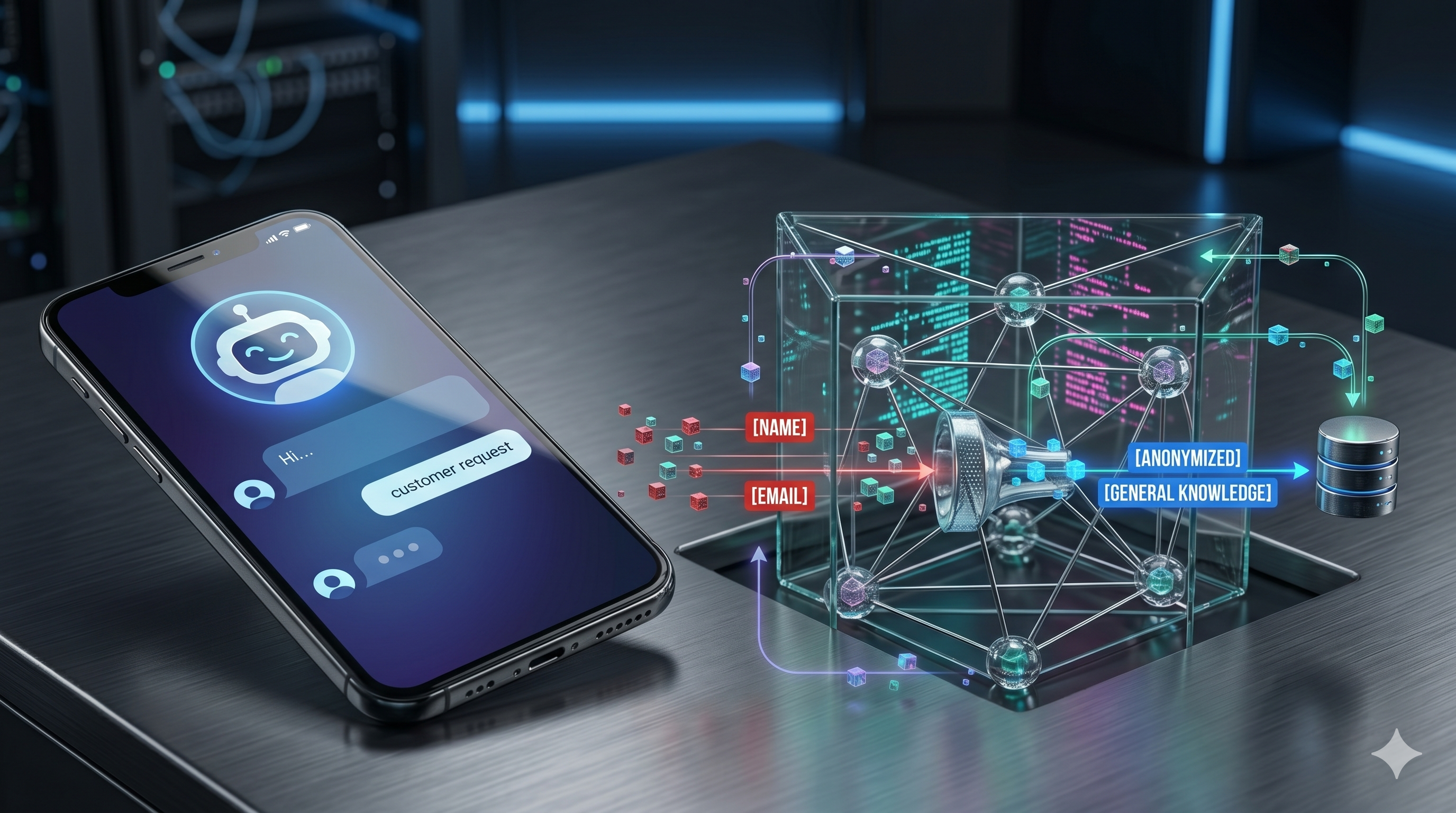
Then, before that rule is saved to the knowledge base, the AI agent automatically strips out all personally identifiable information. Customer names, email addresses, order numbers, and any other sensitive details are anonymized. What gets saved is the principle: the general knowledge that makes the chatbot smarter, not the personal details of the customer whose ticket surfaced it.
This distinction matters for two reasons.
First, it means the knowledge base stays compliant by default. There is no manual review step, no privacy officer sign-off required before a ticket can contribute to chatbot learning. The anonymization happens automatically, every time, as part of the process. Your knowledge base grows continuously without accumulating personal data.
Second, it means the learning is genuinely useful rather than just stored. A rule that says “Price × Quantity” is more valuable than a rule that says “customer Jane Smith asked how much five items at $100 each would cost and the answer was $500.” The first works for any future customer asking any similar pricing question. The second is a specific data point that serves no one and creates privacy risk for the customer whose name is attached to it.
Removing personal data before it reaches the AI model is the safest approach because the AI never sees the raw details in the first place. If your records are ever audited, hacked, or handed to a regulator, there is nothing sensitive in them to expose. LiveAgent’s self-learning loop
works exactly this way: generalize the knowledge, remove the personal details, save only what helps future customers.
What a safe chatbot setup looks like in practice
Beyond the self-learning loop, a few broader principles separate a safe chatbot from a risky one. These apply whether you’re setting up something new or reviewing what you already have.
Collect only what you need
A safe chatbot doesn’t store every detail a customer shares just because it can. Privacy guidance
consistently recommends collecting only what’s strictly necessary for the task at hand. If a customer gives their email address to verify their account, that detail shouldn’t end up in a knowledge base article. If they describe their problem in depth, that description should help resolve the issue but not be kept indefinitely.
Be upfront with customers
95% of organizations
say privacy is essential for earning customer trust in AI-powered services, according to Cisco’s 2025 Data Privacy Benchmark. A big part of that trust comes from being honest. Customers should know they’re talking to a bot — 42% of consumers
think chatbots should always say they’re not human. They should also always be able to reach a real person. 22% of consumers
say not being able to escalate is the most frustrating thing about chatbots, and customers who feel stuck with a bot that can’t help them are unlikely to trust the company behind it.
Handle handoffs properly
When the chatbot passes a conversation to a human agent, the handoff should give the agent what they need to help, and nothing more. Cisco research found
that a third of agents taking over from chatbots don’t have enough information to help the customer effectively, which means customers have to start over. Passing a full conversation log with unnecessary personal details to an agent who only needs a short summary is both a privacy issue and a practical one.
Know who you’re working with
Chatbot providers vary a lot in how they handle customer data. 95% of organizations
say privacy is critical for customer trust, but the controls different platforms actually have in place are very different. Before choosing a chatbot platform, it’s worth asking how conversation data is stored and for how long, whether your data is used to train shared AI models, and what happens if a customer asks for their data to be deleted.
The EU AI Act
is a new law coming into full effect in August 2026 that sets specific requirements for how AI systems handle data, make decisions, and inform users. Companies that don’t meet those requirements face fines. If your chatbot handles customer data and you serve European customers, checking whether your provider is compliant before that deadline is worth doing sooner rather than later.
Chatbot safety and customer trust
Privacy isn’t just a legal requirement. It’s a factor that directly affects whether customers come back.
76% of consumers
say they won’t buy from a company they don’t trust with their data. 83% of consumers
think about data trust before making a purchase. And 64% of consumers
have stopped using a business because of concerns about how it handles their information.
Customer support is where people share some of their most sensitive details. An order number, a billing dispute, an account issue: customers hand over this information because they need help, not because they’ve agreed to have it stored in an AI system. A chatbot that handles that information carelessly doesn’t just create a legal problem. It creates the kind of experience that ends the relationship.
67% of users
feel that chatbots protect their privacy when they are properly set up. That’s a meaningful majority. But it also means a third of users aren’t confident. Earning that confidence usually comes down to decisions customers never see: how data is stored, whether personal details are removed before anything is saved, and whether the knowledge base is built on real learning or on other people’s private conversations.
Conclusion
Chatbots are safe to use when privacy is treated as a requirement rather than something to sort out later. The risks are genuine: customer data getting stored where it shouldn’t, personal information leaking through AI responses, legal penalties for handling data badly. But they are all manageable. The key is getting the right protections in place at every step, including the step most teams miss: what happens to customer data when it is used to teach the chatbot something new.
LiveAgent’s AI self-learning loop
handles this by removing all personal information before anything is saved to the knowledge base. The chatbot gets smarter with every resolved ticket. Customers’ personal details stay in the conversation where they belong. Your knowledge base grows, stays clean, and never puts anyone’s data at risk.
Lilia is a content manager at LiveAgent. Passionate about customer support, she crafts engaging content that highlights the power of seamless communication and exceptional AI-powered service.
Lilia Savko
Copywriter
Frequently asked questions
The main risks in customer support chatbots are storing conversation logs without removing personal details, using raw customer conversations to train AI without anonymizing them first, giving wrong or made-up answers, breaking data protection laws, personal information leaking through AI responses, poor handoffs to human agents that force customers to repeat themselves, and not being upfront with customers about talking to a bot. Most of these are avoidable with the right design from the start.
Yes, when they are built with proper data protections in place. The key risks come from storing personal data without removing it first, training AI on raw customer conversations, and knowledge bases that build up private customer information over time. Platforms that strip personal data automatically before saving anything, like LiveAgent's AI self-learning loop, deal with these risks before they become a problem.
Anything a customer shares to get help: names, email addresses, order numbers, account details, billing information, and the details of their complaint. The risk isn't just in the live conversation. It also exists in stored records, knowledge base entries, and anything derived from those conversations when updating the AI.
Yes, but it depends on how the chatbot is set up and which platform you use. The basic requirements are having a legal reason to process personal data, telling customers they're talking to a bot, giving customers a way to ask for their data to be deleted, and not keeping personal data longer than necessary. Automatically removing personal information before it's used to update the chatbot is one of the most effective ways to stay compliant in practice.
PII stands for personally identifiable information: anything that can be used to identify a specific person, such as their name, email address, phone number, or order number. In a chatbot context it matters because support conversations are full of it. If that information ends up in a knowledge base, gets used to train an AI, or sits in conversation logs without proper controls, it creates legal risk and puts customers' private data in a place it was never meant to be.
Before saving anything to the knowledge base, LiveAgent's AI self-learning loop automatically removes all personal information from the resolved ticket. The AI reads the conversation, works out what the chatbot missed, turns the agent's solution into a general rule, and strips out the personal details before saving that rule. Only the useful knowledge stays. Customer data is never stored as part of the learning process.
The key questions to ask any provider are: how long is conversation data kept; is your data used to train AI models that other customers also use; are personal details removed automatically before being used to update the chatbot; and how does the platform handle requests from customers who want their data deleted. If you have customers in Europe, also check whether the provider is ready for the EU AI Act requirements coming into effect in 2026.
What Shopify merchants need to know about AI chatbots
Shopify merchants often wonder whether AI chatbots can truly handle the growing volume of customer inquiries efficiently. Many ask if a chatbot can provide inst...
LiveAgent's AI Chatbot is your efficient first point of contact. Powered by advanced LLM, trained on your data, and seamlessly integrated into chat support. Try...
A step-by-step buyer's checklist for choosing an AI chatbot in 2026: use case, channels, budget, integrations, a week-1 pilot, red flags, and a scorecard.
8 min read
AI
Chatbots
+3
Cookie Consent We use cookies to enhance your browsing experience and analyze our traffic. See our privacy policy.