



In this article:
- Will AI replace human customer service agents?
- Where does AI beat human agents?
- Where do human agents still win?
- AI vs human customer service: what does the data say?
- How should you split work between AI and humans?
- How does LiveAgent handle the handover?
Every support lead is asked the same question sooner or later: will AI replace customer service teams? The AI vs human customer service debate is loud, but the research is more measured. Recent research points to “some of the work, not all of it, and not without a way back to a person.” This article sticks to published research with a stated sample, and it says plainly where the numbers are self-reported or come from a vendor. Where no reliable number exists, such as AI versus human cost per contact, we leave it out rather than guess. LiveAgent is our product; the last section covers it.
If you are new to the topic, start with what an AI customer service agent is and does, then come back here to see how it compares with a person.
Will AI replace human customer service agents?
Probably not fully, and customers are clear about why. In an August 2026 Gartner survey of 3,566 customers, 50% said interactions were easier when companies used GenAI (generative AI, the technology behind tools like ChatGPT). Yet 87% said it is essential that companies offer a way to reach a human agent when they do.
Trust runs the same way in Five9’s 2026 research (3,000 consumers and 600 decision-makers in the US, UK and Germany). 80% of consumers said they were willing to use AI-powered customer service, but two-thirds still prefer speaking with a human. Willing to try and happy to depend on are two different things.
The forecasts from the industry side are aggressive. Cisco’s 2025 survey of 7,950 business and technical decision-makers predicts agentic AI (AI that carries out tasks on its own, not just answers questions) will handle 68% of customer service and support interactions with technology vendors by 2028. Salesforce’s State of Service report (6,500 service professionals, published November 2025) says teams report AI handling 30% of cases in 2025, rising to 50% by 2027. Both are expectations and self-reported estimates, not measured results, so treat them as direction, not fact.
Where does AI beat human agents?
AI wins where the work is repetitive, the answer is written down and the customer wants it now.
- Availability. Zendesk’s CX Trends 2026 (11,000+ respondents in 22 countries) found 74% of consumers now expect 24/7 service because of AI. A bot does not have a night shift.
- Speed on routine contacts. Freshworks’ 2026 benchmark , drawn from more than 33,000 customer accounts and 1.2 billion tickets, shows resolution times falling from more than nine minutes to under five. The report does not prove AI is the only cause, but nearly 44% of teams now use AI, up from 32% a year earlier.
- Helping people, not replacing them. In a peer-reviewed study of 5,179 support agents (Brynjolfsson, Li and Raymond , published in the Quarterly Journal of Economics in 2025), access to an AI assistant raised productivity by 14% on average and by about 34% for novice and lower-skilled agents. Salesforce also reports that reps using AI spend 20% less time on routine cases, about four hours a week.
Of the three, the assistant role has the strongest evidence behind it.
Where do human agents still win?
People win when the case is messy, emotional or expensive to get wrong.
- Failed bot experiences cost trust. Qualtrics’ 2026 Consumer Experience Trends report (20,000+ consumers in 14 countries, Q3 2025) found 19% of consumers who used AI for customer service saw no benefit from it, a failure rate the report puts at four times that of other AI uses. Half are concerned AI will stop them from reaching a person.
- Stuck customers stop using the tool. Gartner’s August 2026 survey also found that when customers are forced through several unsuccessful AI interactions before reaching a person, they are less likely to use that tool again.
- One bad outcome is enough. Zendesk’s 2026 report found 85% of CX leaders say a single unresolved issue is enough to lose a customer.
- Customers hate repeating themselves. Zendesk reports 74% of consumers are frustrated when they have to repeat information, and Five9’s 2026 research found 83% still have to repeat themselves at least sometimes after a transfer.
Notice that the last two points are about handover, not about the AI’s answers. Many “AI failures” are really failures to pass the conversation on properly. If you want to check whether your own bot has this problem, our list of chatbot problems gives you five measurable warning signs.
AI vs human customer service: what does the data say?
AI wins on availability and speed for routine contacts, people win on trust and complex cases, and cost is the one row with no reliable independent number.
| Question | AI agent | Human agent | Source and caveat |
|---|---|---|---|
| Available 24/7 | Yes | Only with shift cover | Zendesk 2026: 74% of consumers expect it |
| Speed on routine questions | Instant | Minutes to hours | Freshworks 2026: average resolution time under five minutes |
| Customer preference | Willing to try (80%) | Preferred by two-thirds | Five9 2026, US, UK, Germany |
| Access to a person | Not enough on its own | Expected (87%) | Gartner Aug 2026 |
| Complex or emotional cases | Often fails | Stronger | Qualtrics 2026 report: 19% saw no benefit from AI |
| Effect on agent output | Up 14% on average with an AI assistant | Baseline | NBER / QJE, older 2023 data |
| Cost per contact | No reliable independent figure found | No reliable independent figure found | Ask vendors for method, not a headline |
The last row matters. Numbers that compare cost per contact for AI and people usually come from vendors or roundups. Compare cost using your own ticket data.

Join our newsletter
The latest tips and deals delivered straight to your inbox.
How should you split work between AI and humans?
Sort contacts by how risky a wrong answer is and how clear the correct answer is.
| Type of contact | Who leads | Why |
|---|---|---|
| Order status, hours, password resets | AI | One correct answer, low risk |
| How-to questions covered by your knowledge base | AI, with a human fallback | Clear answer, but wording matters |
| Billing questions and refunds | Human, AI drafts the reply | Money is involved |
| Complaints and cancellations | Human | Emotion and retention are at stake |
| Account security, legal or safety topics | Human only | A wrong answer is costly |
| Anything a customer asks a person for | Human | Gartner: 87% expect that option |
Three rules keep this working in practice:
- Tell customers when they are talking to an AI. Five9’s 2026 research found 71% consider that very or extremely important.
- Hand over early, with the full conversation. Do not make a customer fail three times first.
- Measure per topic. Track resolution, satisfaction and repeat contacts for each contact type, so a strong average does not hide a weak spot.
Before you buy anything, it helps to know what to ask any AI chatbot vendor , and how AI and human support work best together once it is live.
How does LiveAgent handle the handover?
The failure modes above are what LiveAgent’s AI Human Handover is built around. A conversation can move from the chatbot to a human agent with the full chat history kept, so the customer does not start again. Visitors can also ask for a person when they want one, and agents can take over a conversation in progress.
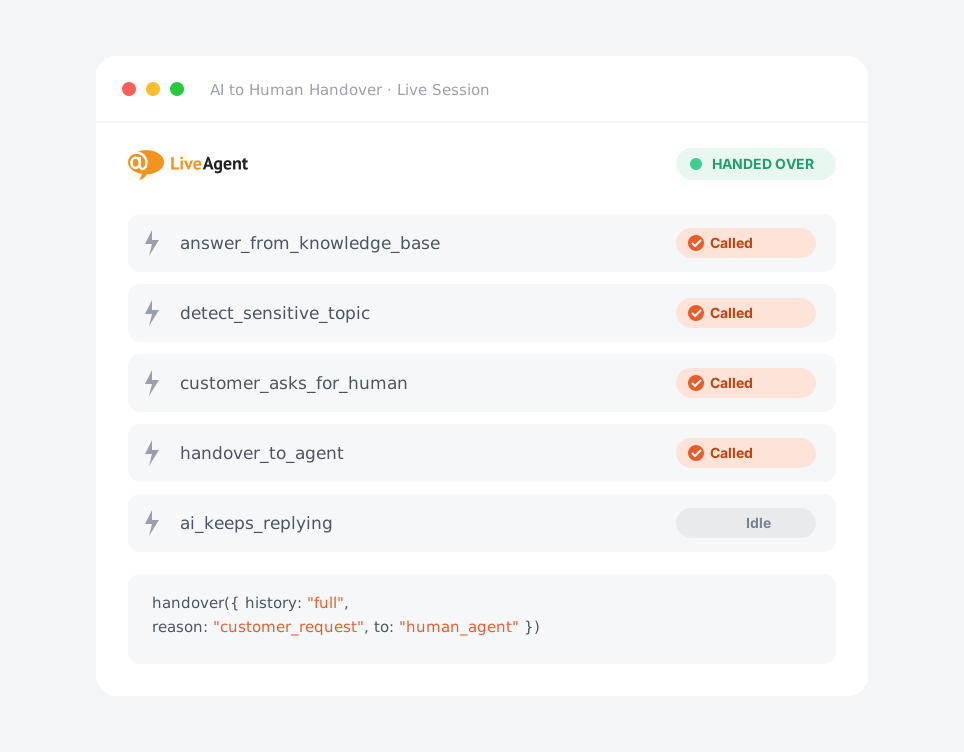
LiveAgent’s AI is designed to sit alongside your team, not replace it. If you want the setup steps, see how to deploy an AI customer service agent in your own help desk.
For routine contacts, AI is increasingly taking over. For the whole job, the data says no: customers want AI’s speed and a person within reach.
You can try the handover on your own conversations with a free LiveAgent trial .