What is ticket validation, and why does it stop your team wasting time on invalid requests?
Incomplete, duplicate, and misrouted tickets quietly drain agent time. Learn what ticket validation is, why it matters, and how AI can catch these tickets before they reach your queue.
Published on Jul 31, 2026.
Blog
Customer Support
AI Features
Automation
Help Desk
Every support team has the same quiet time-waster: tickets that never should have reached an agent in the first place. A request missing the order number. A duplicate of something already answered yesterday. A message sent to the wrong department entirely. None of these are hard to solve, but each one still takes an agent’s attention away from the tickets that actually need it.
Ticket validation is the fix for that specific problem, and it’s exactly what LiveAgent’s AI ticket validation and autoresponse
feature is built to solve.
What is ticket validation?
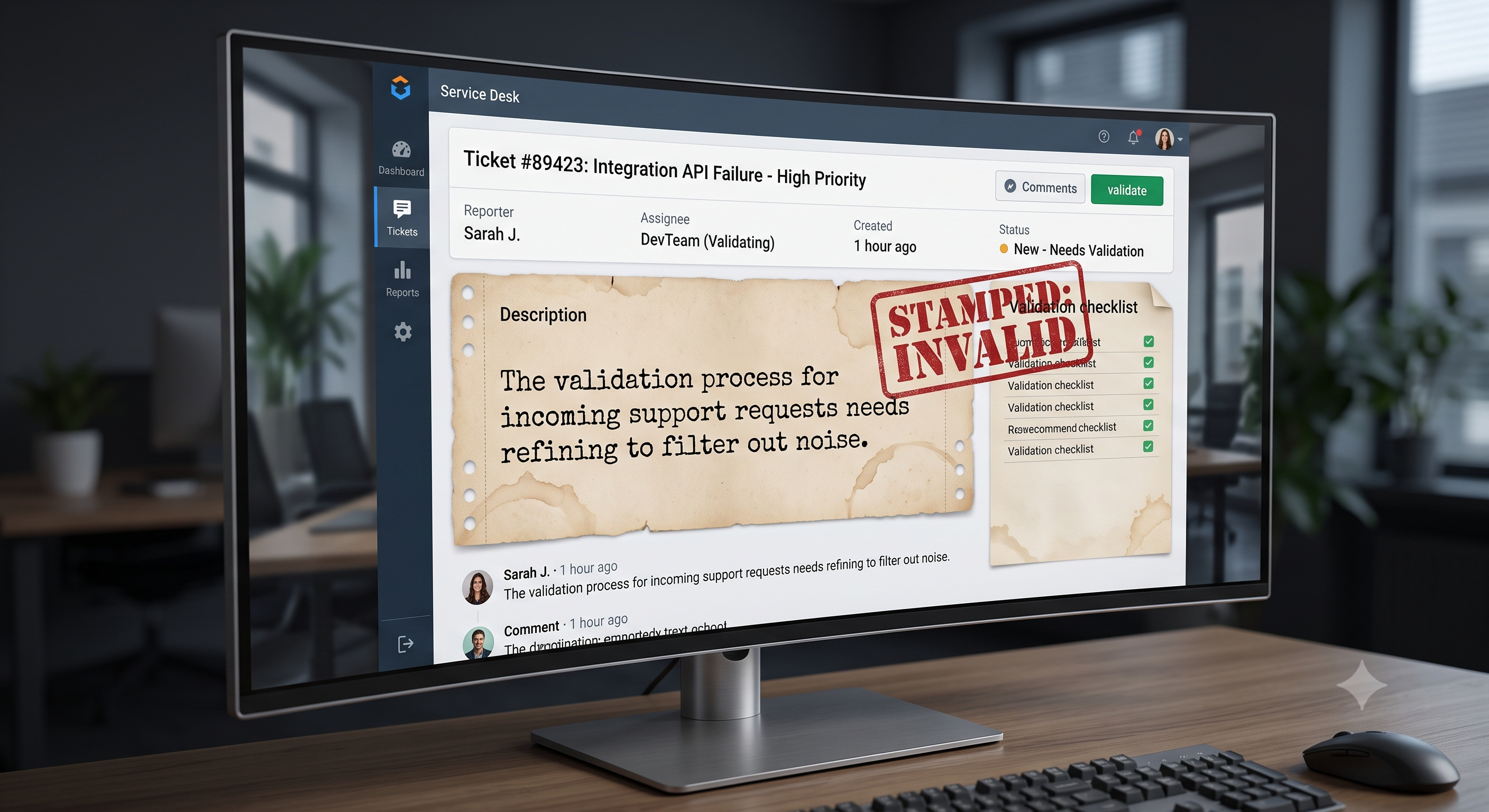
Ticket validation is the process of checking an incoming support request against a set of rules before it lands in an agent’s queue. Instead of every message going straight to a human, the system checks whether the ticket has what it needs to actually be worked on: the right information, the right department, a request that isn’t a duplicate or already resolved.
If something’s missing or off, the ticket gets flagged, routed, or automatically answered, rather than sitting in the queue as dead weight until an agent opens it, realizes something’s wrong, and has to follow up just to get the basics.
Why invalid tickets are more expensive than they look
A single incomplete ticket doesn’t feel like much. But add up the pattern across a week, and it becomes a real cost:
Agents open tickets they can’t act on. Every “can you send your order number?” reply is a full context switch, for a problem that could have been caught before the ticket ever reached them.
Response times quietly inflate. A ticket that bounces back and forth for missing information takes two or three times as long to close as one that arrived complete.
Real requests wait longer. Every minute spent chasing basic details on an invalid ticket is a minute not spent on a customer with an actual, solvable problem.
Duplicate and spam tickets clutter reporting. Metrics like average handle time and ticket volume get distorted by tickets that were never going to need real work.
None of this shows up as one big dramatic failure. It shows up as a slow, steady drag on team efficiency that’s easy to miss until you actually measure it.
Ready to grow your business?
Start your free trial today and see results within days.
With LiveAgent’s AI ticket validation and autoresponse
, incoming tickets are checked automatically the moment they arrive, before an agent ever sees them:
Missing information gets flagged. If a ticket is missing something the team needs to act (an order number, account email, or other required detail), the system can automatically ask the customer for it, rather than leaving that step to an agent.
Duplicate or already-answered requests get caught. Tickets that match an existing open conversation or a recently resolved one get identified instead of creating a second parallel thread.
Invalid or out-of-scope requests get routed correctly, so a request meant for billing doesn’t sit untouched in the technical support queue.
Genuinely complete, valid tickets pass straight through to the right agent, with nothing lost in the process.
The result isn’t fewer tickets overall. It’s fewer tickets that require a human simply to point out what’s missing.
What this actually changes for a support team
Teams that put validation in front of their queue tend to notice the same few things:
Agents spend their time on tickets that are actually solvable on first contact
Average handle time drops, not because agents work faster, but because they’re not stuck untangling incomplete requests
Reporting becomes more accurate, since ticket volume and resolution metrics reflect real work instead of back-and-forth noise
Customers get faster answers when their request was valid to begin with, since it isn’t sitting behind a pile of tickets that needed cleanup first
Join our newsletter
The latest tips and deals delivered straight to your inbox.
Is this the same as spam filtering?
Not quite, though the two work well together. Spam filtering
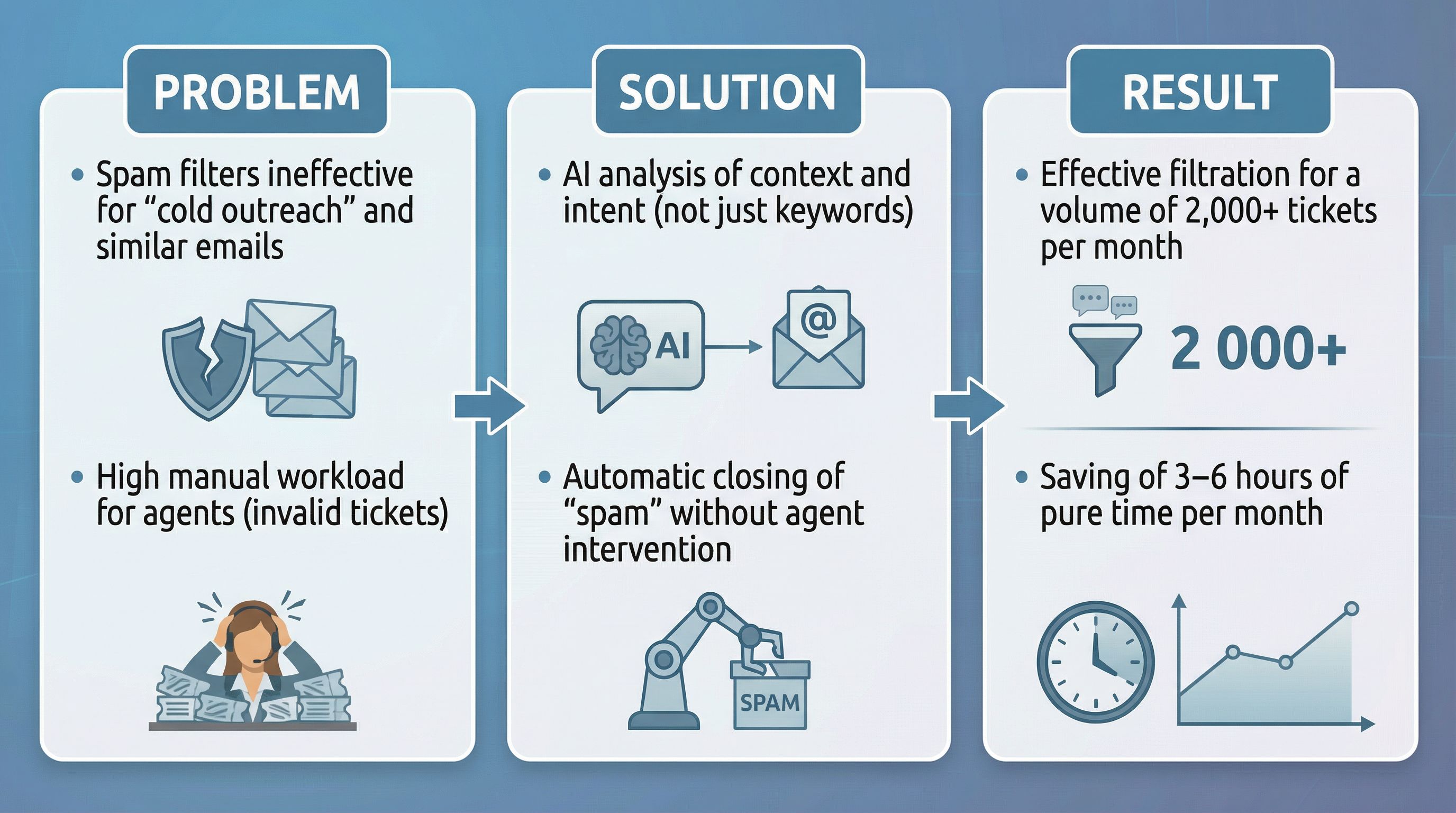
catches messages that were never legitimate support requests at all: bot traffic, irrelevant marketing replies, out-of-office auto-replies looping back into the queue. Ticket validation is a level up from that. It assumes the message is a real request from a real customer, and checks whether that request actually has what it needs to be resolved.
Used together, spam filtering clears out what shouldn’t be in the queue at all, and ticket validation makes sure what remains is actually ready to work on.
Where this fits into a bigger automation strategy
Ticket validation works best as one part of a broader approach to reducing manual ticket handling, alongside features like AI ticket triage and categorization
, which sorts valid tickets to the right team once they’ve passed the initial check. Validation decides whether a ticket is ready to be worked on. Triage decides who should work on it. Together, they cut out most of the manual sorting that used to fall entirely on agents.
If your team is still manually chasing missing details on incomplete tickets, that’s usually the clearest sign it’s time to add validation in front of your queue
, not more agents behind it.
LiveAgent's AI ticket validation and autoresponse agent automatically screens incoming support tickets for relevance and clarity, then generates accurate, knowl...