



In this article:
- What Tier-1 support actually means
- Fundrise: 50%+ of support cases in under 3 months
- Lightspeed Commerce: 65% resolved, CSAT went up
- Chime: 60% lower cost, satisfaction doubled
- Duolingo: 80% of chat deflected
- ClassPass: cost cut 95%, deflection beat their own estimate
- What these 5 teams actually have in common
Most examples of AI in customer service describe what an AI agent could theoretically do. This one only uses cases where a real company published a real number, with a named source, so you can check it yourself instead of taking a blog’s word for it.
None of the five companies below use LiveAgent. We’re citing their own published results as evidence for the pattern, not as an endorsement of the tools they used.
What Tier-1 support actually means
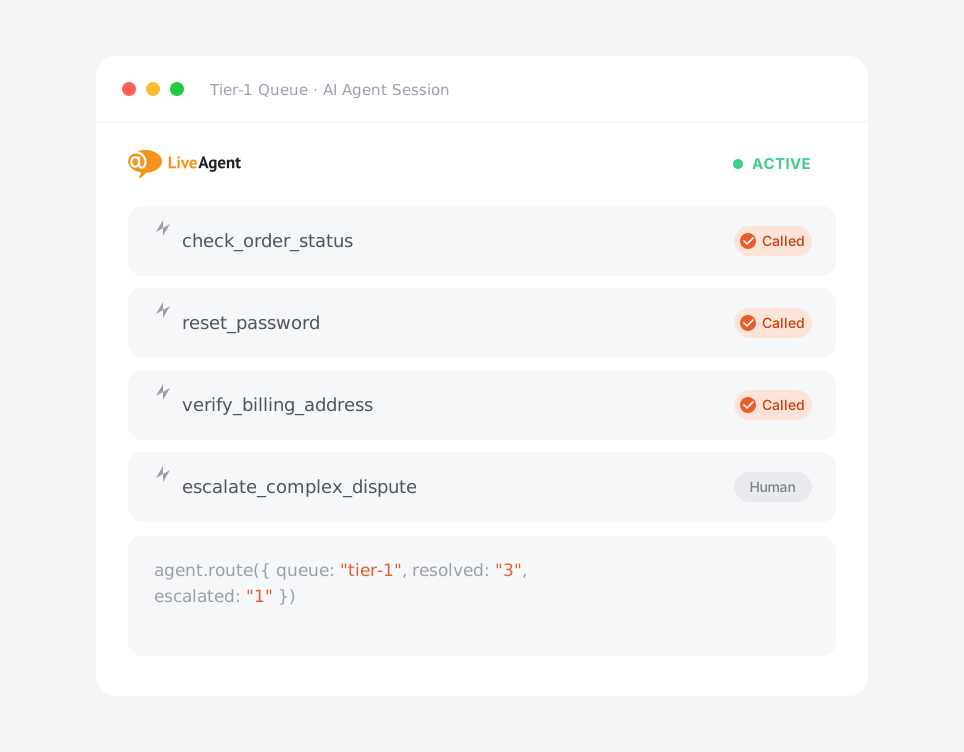
Tier-1 is the first layer of any support queue: routine questions that don’t need specialist knowledge to answer correctly. Order status. Password resets. Billing basics. Account changes. It’s also, in most teams, the layer that eats the most agent hours for the least reward, since a skilled agent spends the same ten minutes on a routine question as a junior one would.
That’s exactly why it’s the layer every example below started with. None of these five teams tried to automate their hardest tickets first.
Fundrise: 50%+ of support cases in under 3 months
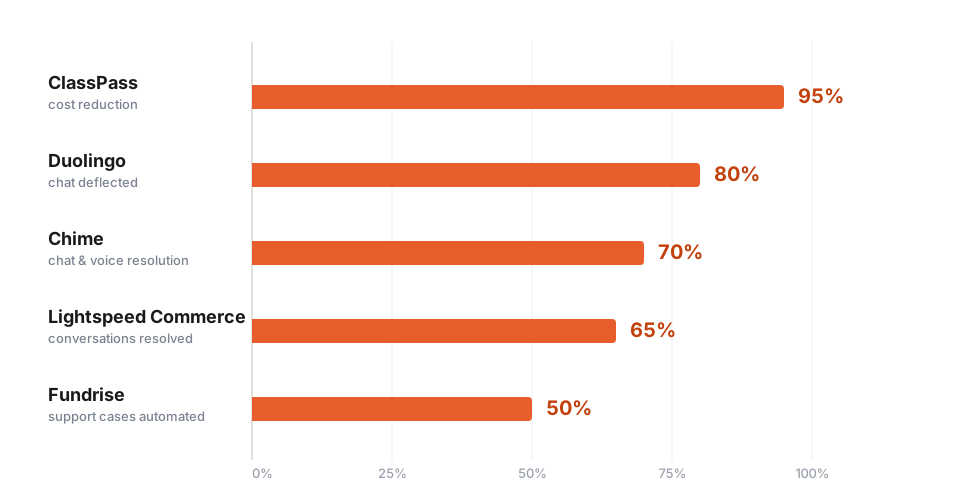
Fundrise , a direct-to-investor real estate platform, deployed Intercom’s Fin AI agent to handle its growing support volume without adding headcount. Luke Ruth, Fundrise’s Chief Product Officer, said: “Less than three months after launching Fin, it now handles more than 50% of our total support cases.”
The context matters here as much as the number. Fundrise was trying to keep response times fast for a growing investor base while still leaving room for agents to give thoughtful answers to complex financial questions, the kind of question that shouldn’t go to an AI agent at all. Automating the routine half of the queue is what created that room.
Lightspeed Commerce: 65% resolved, CSAT went up
Lightspeed Commerce , a global e-commerce and point-of-sale platform, runs Fin across a support team split between longtime Intercom users and agents new to the tool. Fin now participates in 99% of conversations and autonomously resolves up to 65% of them.
The number worth paying attention to isn’t the resolution rate. It’s that Fin CSAT rose 60% alongside it, while chat response times dropped 38% and email response times dropped 67%. The common assumption is that automating support trades speed for quality. Lightspeed’s numbers say the opposite happened, once the AI agent had full control over when to hand a conversation to a human instead of forcing every case through it first.
Chime: 60% lower cost, satisfaction doubled
Chime , a fintech company, deployed Decagon’s AI agent and reported a 60% decrease in customer support costs, a 70% chat and voice resolution rate, and a doubled member satisfaction score in the process.
Cost and satisfaction moving in the same direction, instead of trading off against each other, is the least intuitive part of Chime’s result. It only makes sense once you separate what got automated (the routine, high-volume share of the queue) from what stayed with agents (the questions where a human genuinely adds value). Neither side got worse. Each side got more of what it was actually good at.

Join our newsletter
The latest tips and deals delivered straight to your inbox.
Duolingo: 80% of chat deflected
Duolingo deployed Decagon’s AI agent and reported an 80% chat deflection rate, meaning 4 out of every 5 chat inquiries never reach a human agent at all. The case study doesn’t break down exactly which categories make up that 80%, but the stated effect is that human agents now spend their time on the more complex inquiries the deflected volume used to crowd out.
At Duolingo’s scale, an 80% deflection rate isn’t a small efficiency gain. It’s the difference between a support team that can keep up with a growing user base and one that structurally can’t, without either hiring at the same pace or accepting slower answers.
ClassPass: cost cut 95%, deflection beat their own estimate
ClassPass , a fitness and wellness subscription platform, already ran a mature program for understanding what could be deflected before deploying Decagon’s AI agent. Even with that head start, the team said: “We saw 10x higher deflection at launch than we anticipated,” alongside a reported 95% reduction in support costs.
That detail is the most useful one in this whole list. ClassPass wasn’t guessing. They had existing customer research and still underestimated what the AI agent could take off their queue by an order of magnitude. If a team with a mature program can be off by 10x, most teams deploying for the first time should expect their own early estimate to be wrong too, in the same direction.
What these 5 teams actually have in common
Strip away the vendor names and the five results above share the same shape:
| Team | Automated | Main result |
|---|---|---|
| Fundrise | 50%+ of support cases | Full-time reallocation of agent hours to complex questions in under 3 months |
| Lightspeed Commerce | 65% of conversations | Resolution AND satisfaction rose together, not traded off |
| Chime | Routine chat/voice volume | 60% lower cost, satisfaction doubled |
| Duolingo | 80% of chat | Support kept pace with a growing user base without matching headcount growth |
| ClassPass | Far more than expected | 95% cost cut, 10x their own deflection estimate |
None of them automated everything. All five kept a human layer for anything outside the AI agent’s scope. And in every case, the team started with the routine, repetitive share of the queue, the Tier-1 layer, not the hardest tickets they had.
That’s the actual takeaway, more than any single percentage: the pattern isn’t “replace support with AI.” It’s “stop spending skilled agent time on unskilled questions,” and let the numbers follow from there. If you’re ready to test this on your own queue, our guide on deploying an AI customer service agent covers exactly how to scope that first phase, and setting up an AI agent in LiveAgent covers the LiveAgent-specific configuration steps.