



Meeting Follow-Up Email Templates
Learn to craft professional meeting follow-up emails with LiveAgent's templates. Recap key decisions, express gratitude, and outline next steps to ensure clarit...
10 min read
LiveAgent
Email Templates
+1
Learn to craft effective project summaries with templates for internal and external use. Capture key objectives, progress, and results to keep stakeholders informed and aligned. Ideal for tracking, improvement, and securing future project support.
A project summary is an original document that gives an overview of a project, its objectives, and the results achieved. This allows the parties involved to track progress, identify areas for improvement, and have points of reference down the line. This type of report informs key stakeholders about the stage of completion and actionable project findings.
In this article, we will provide you with various example project summary report templates for different scenarios so that you don’t have to create your own report from scratch.
On top of this, some good practices and writing tips will be shared to help you tailor the key elements of each project summary to your own needs and up your project management game in the process.
A concise and comprehensive project overview is an effective project management tool that simplifies processes and gets all team members and stakeholders on the same page.
For internal company use, a project summary shows the progress of a project to employees, project managers, contractors, and other service providers. It demonstrates project milestones, metrics, and timeline updates to keep teams on track, help them stay organized, and get them working together efficiently.
Externally, a project summary is used as a brief to present or provide updates to the project stakeholders, and can be helpful in obtaining funding or support for future projects. For this purpose, the document resembles a set of project proposals to give the reader a quick impression of the nature, status, and overall context of the project.
The heading should be reflective of the purpose or focus of the document. A good rule of thumb is to use a title that is specific and informative, yet still concise. For example, the project name followed by the words “project update”, “progress report”, or “project summary”, etc.
You can also use the project’s code name as the title of the summary if it is more appropriate for internal purposes.
Furthermore, the title can also include the timeframe of the project to give the reader a better idea of what they can expect from the document. For instance, also add the month or the quarter and the year, or ‘year-to-date".
During the writing process, it’s important to keep in mind the purpose of the document as well as your audience. A project summary should address the following questions:
The answers to these questions will give you a good starting point for writing your project summary. Remember to also include any relevant information that would be helpful for the reader to know, such as background information on the project and key dates or deadlines, etc.
Once you have gathered all of the necessary information, you can start writing your project summary.
Begin by introducing the project and providing an overview of what it is about. Next, list the objectives of the project and describe the results that have been achieved so far. Finally, conclude with a brief description of the next steps for the project.

The latest tips and deals delivered straight to your inbox.
Table of Contents:
Objectives:
Team:
Stakeholders:
Description: The [Project Name]: Project Summary is a document that demonstrates project milestones, metrics, and timeline updates to keep the team on track, help them stay organized, and get them working together efficiently. It is also used as a project brief to provide updates on the project to the stakeholders.
Timeline:
Deliverables:
Overview:
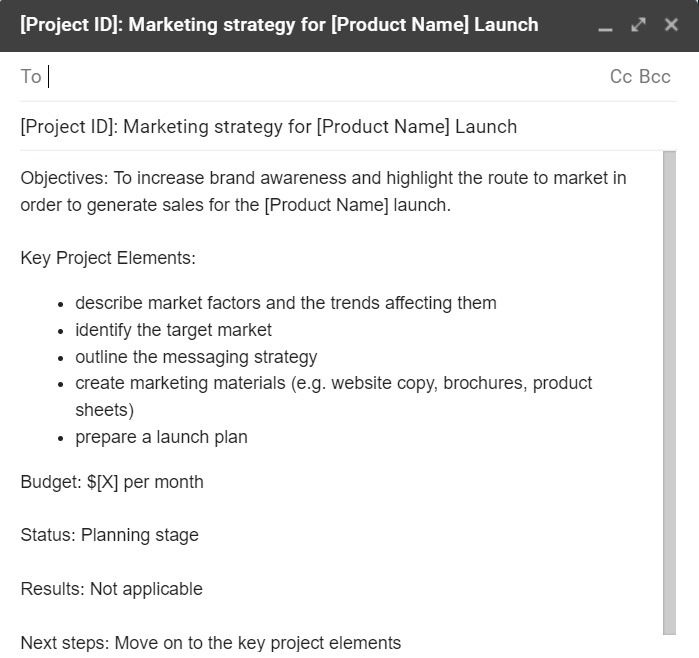
Objectives: To increase brand awareness and highlight the route to market in order to generate sales for the [Product Name] launch.
Key Project Elements:
Budget: $[X] per month
Status: Planning stage
Results: Not applicable
Next steps: Move on to the key project elements
Project Manager: [Name], [Contact Details]
Objectives: To update stakeholders on the status of [Project ID] regarding the launch of [Product Name] as of [Current Date].
Status: Successful
Results: The marketing campaign has resulted in a [e.g. high] level of brand awareness and has generated interest in the [Product Name] launch.
Next steps: Continue to generate sales, increase the company’s market share, and monitor the results of the market strategy.
Date: [Current Date]
Project Period: [Start Date] to [End Date]
Project Manager: [Name], [Contact Details]
Objectives: To increase company productivity by implementing new software
Results: The new software has been successfully implemented and has resulted in an increase in company productivity.
Next steps: Track the results of the new software and make any necessary adjustments.
Objectives: To improve customer satisfaction by providing better customer service
Results: The customer experience has improved as a result of the new customer service initiatives.
Next steps: Continue monitoring satisfaction levels among our customer base by gathering opinions through customer feedback sessions and to make any necessary adjustments.
Description: The [Project Name] executive summary is a document that provides an overview of the key points of the business plan.
Overview:
Problem Summary:
Solution Summary: [How Project Name solves Pain Point]
Market Analysis:
Key Next Steps:
Financial Summary:
Date: [Current Date]
Principal Investigator: [Name], [Position], [Company Name]
Objectives:
Results:
Next Steps – to proceed with the project proposal, the following steps are recommended:
Executive Summary
Background
Proposal
Appendix
Executive Summary:
Background:
Proposal:
Appendix:
By following these tips, you can be sure that your project summary will be effective in communicating the progress of your project to stakeholders. Tailoring your summary to your target audience will also ensure that you are providing the most relevant information. Project summaries can be a valuable tool in obtaining funding or support for future projects, so make sure to put care into crafting yours.
With a little planning and the use of customizable templates you can create a high-level overview of your project. By including key information such as the project title, start and end date, objectives, and results achieved, give stakeholders a clear picture of the progress on your project. After some careful proofreading, your project summary will be ready to be shared with your team and stakeholders.
Learn to craft professional meeting follow-up emails with LiveAgent's templates. Recap key decisions, express gratitude, and outline next steps to ensure clarit...
Discover effective business proposal writing with free templates. Learn to craft persuasive pitches to win over potential clients!

Discover effective communication plan templates to engage stakeholders, manage crises, and launch campaigns smoothly. Start planning today!
Cookie Consent
We use cookies to enhance your browsing experience and analyze our traffic. See our privacy policy.