

Nicereply
Integrate Nicereply with LiveAgent to measure customer satisfaction through customized CSAT surveys and analytics. Collect real-time feedback from customers, tr...
4 min read

Master Net Promoter Score (NPS) to measure customer loyalty and drive business growth with proven strategies and best practices.
Providing excellent customer service not only ensures their satisfaction but also helps you build strong, long-lasting relationships. But how do you know if your customer service efforts are paying off? That’s where customer service metrics come into play. Among the most important metrics is the Net Promoter Score (NPS), which measures the likelihood of customers recommending your business to others.
NPS is a powerful indicator of customer loyalty and can directly impact your business growth through word-of-mouth marketing and customer retention. In this comprehensive guide, we’ll explore what NPS is, how to calculate it, strategies to improve it, and best practices for implementation.
Net Promoter Score (NPS) measures the likelihood of customers recommending your business to others. Several factors can influence your NPS, such as customer satisfaction, product quality, service reliability, and overall customer experience. By understanding their impact on NPS, you can identify areas where improvements are needed.
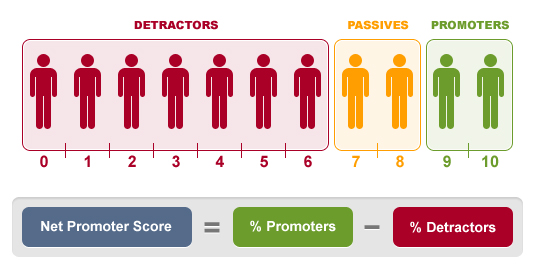
NPS is based on a simple question: ‘On a scale of 0-10, how likely are you to recommend our brand?" The answer to this question categorizes customers into three distinct groups.
In the case of NPS, customers are categorized into three groups based on their response to the recommendation question:
Promoters represent the most enthusiastic and loyal customers. They are more likely to:
Promoters are your most valuable customers and are instrumental in driving organic growth through referrals and positive word-of-mouth marketing.
Passives usually do not actively recommend a brand, but they are also unlikely to damage its reputation with negative reviews. Although they are not included in the calculation of your NPS, they are very close to being promoters. This means you can discover what is holding them back and win them over.
Passives represent an opportunity for growth. With the right improvements or incentives, they can become promoters and significantly boost your NPS.
Detractors are unlikely to recommend a brand or its products to others, and in many cases, they will not repeat purchases. They are also the ones that are more likely to:
Detractors represent a risk to your business and should be a priority for improvement efforts.
Calculating your NPS is straightforward. Here’s the step-by-step process:
Ask your customers: ‘On a scale of 0-10, how likely are you to recommend our brand?"
Based on their response, customers are classified as:
Calculate the percentage of respondents in each category:
The NPS is then calculated by subtracting the percentage of Detractors from the percentage of Promoters:
NPS = % of Promoters – % of Detractors
Let’s say you surveyed 100 customers with the following results:
Your calculation would be:
In this example, your NPS would be 55, which is considered a strong score.
Understanding what constitutes a good NPS score is important for context:
Keep in mind that NPS benchmarks vary by industry. For example, technology companies often have higher average NPS scores than retail or telecommunications companies.
The first step to improving NPS is understanding why customers are unhappy:
Passives are on the fence and represent significant growth potential:
Your promoters are your best marketing asset:
Systematic improvements across all touchpoints will boost NPS:
Customers expect seamless support across all channels:
Don’t just look at overall NPS; segment by:
Make sure customers know you’re listening:
NPS improvement requires company-wide commitment:
Leverage tools to streamline NPS management:
While NPS is powerful, it works best alongside other customer metrics:
CSAT measures satisfaction with specific interactions or products on a scale of 1-5 or 1-10. While NPS measures long-term loyalty, CSAT provides immediate feedback on specific touchpoints.
CES measures how much effort customers must expend to resolve an issue or complete a task. Lower effort correlates with higher satisfaction and loyalty.
CRR measures the percentage of customers who continue doing business with you over time. It’s a practical indicator of loyalty that directly impacts revenue.
Many companies focus only on promoters and detractors, overlooking the opportunity to convert passives. These customers are close to becoming promoters and represent significant growth potential.
Collecting NPS data without taking action is counterproductive. Customers notice when their feedback leads to improvements, which further boosts loyalty.
Annual NPS surveys don’t provide enough data to identify trends or measure the impact of improvements. More frequent measurement is essential.
NPS scores vary significantly by industry. Comparing your score to a company in a different sector can be misleading. Focus on industry benchmarks and your own trends.
While NPS is valuable, it shouldn’t be your only metric. Use it alongside CSAT, CES, and other indicators for a complete picture of customer health.
LiveAgent provides comprehensive tools to measure and improve your NPS:
With LiveAgent’s unified platform, you can collect feedback, analyze results, and take action to improve customer loyalty and drive business growth.
Net Promoter Score is a powerful metric for measuring customer loyalty and predicting business growth. By understanding your NPS, categorizing customers into promoters, passives, and detractors, and implementing targeted strategies to improve each segment, you can significantly boost customer advocacy and drive sustainable business growth.
Remember that improving NPS is an ongoing process. Regular measurement, continuous feedback collection, and consistent action on customer insights are essential for long-term success. Start by surveying your customers today, analyze the results, and implement improvements based on what you learn.
The investment in understanding and improving your NPS will pay dividends through increased customer loyalty, positive word-of-mouth marketing, and ultimately, business growth. With tools like LiveAgent supporting your efforts, you can create a customer-centric organization that thrives on customer advocacy and loyalty.
Share this article
Integrate Nicereply with LiveAgent to measure customer satisfaction through customized CSAT surveys and analytics. Collect real-time feedback from customers, tr...
Simplesat integrates with LiveAgent to manage customer feedback via customizable NPS and CSAT surveys. It offers easy integration for ticket email notifications...

Discover customer satisfaction strategies to boost loyalty, retention, and brand reputation. Learn best practices and actionable tips today!
Join our community of happy clients and provide excellent customer support with LiveAgent.